
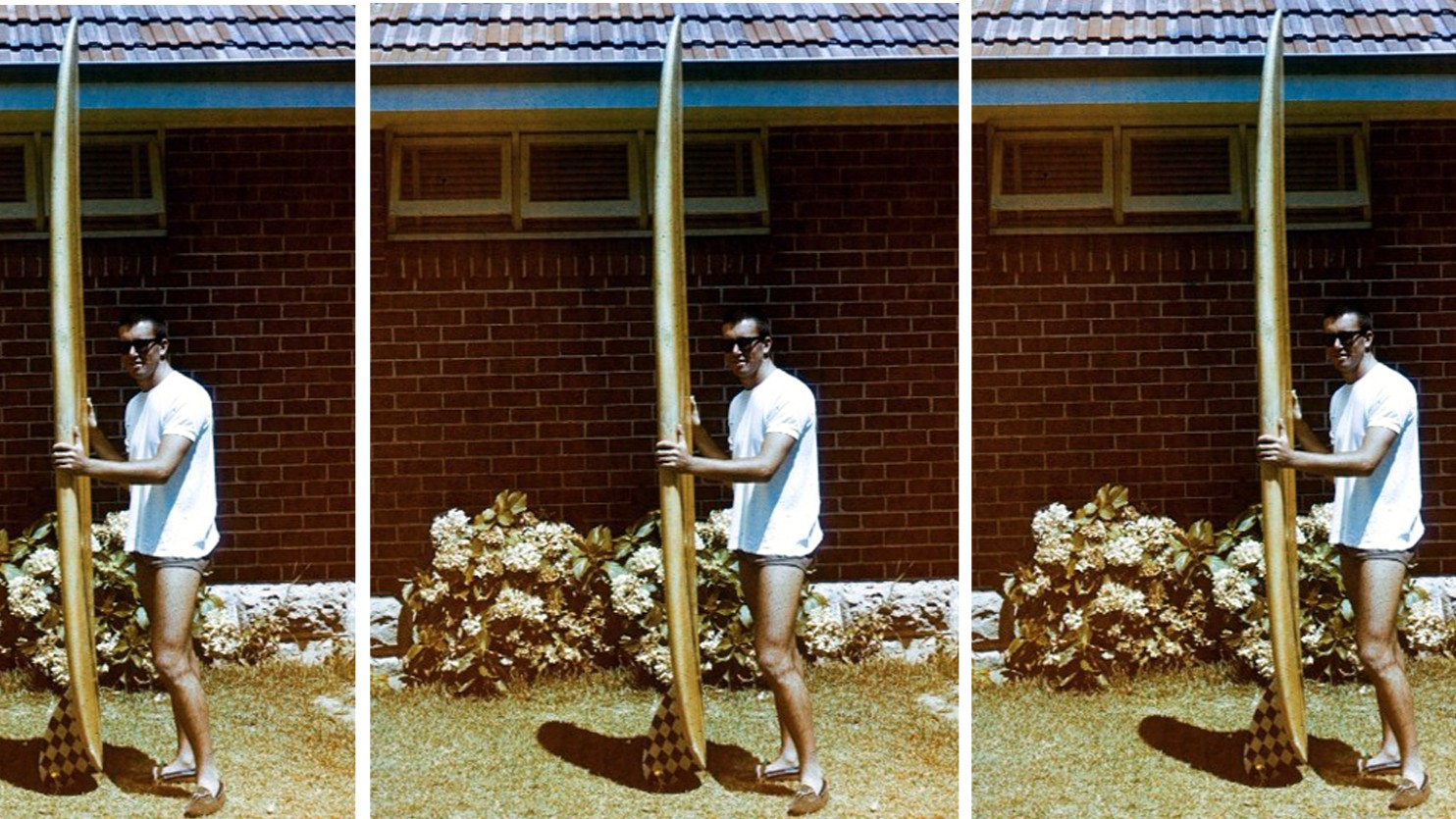
I am part of surfing history in WA, but just from 1955 to 1964…I actually left Perth on Jan 1, 1964 for Sydney, where I met a girl from the USA…end of story, if you know what I mean. Now I’m in my mid-80s and just a bit of surfing history from Waikiki, Hawaii…and a member of the now defunct Rack-Pack.

2021 Anthony ‘Tony’ Allan Wegener Logan, Utah, USA
Tony’s WA Surfing History
Note: This account of Tony’s surfing experiences is an extract from his Personal History, originally written for his family members, rather than the general public. It references Family Members.
Early Surfing in WA (1938): I cannot remember a time in my youth, when life was not connected to the beach. Life was all about Sun, Sand and Surf. My father Allan had been a surfer. He used the old stand-up surf skis which were popular before, during and after WWII. The rider used a long pole with paddle blades at each end to propel the ski from a standing position. The pole was tied to the nose of the board. It was hard work to get the ski moving fast enough to catch a wave. Then the rider had to lean back and pull the nose up, to prevent a nose-dive. The board itself was relatively short, fat, wide, heavy…and leaky. They were not particularly beautiful; they were clumsy looking. They were not fast; they were not maneuverable…in fact they went straight if you were lucky…and they were certainly not portable enough to be really popular. One man could hardly carry one on his back. But we have a photo of Dad with a ski. He was a pioneer surfer at Scarborough Beach.

1938 Allan Wegener with surf ski Scarborough WA.

1946 Stand up paddle boards take to the waves at City Beach West Australia, just after the finish of World War 2. Image courtesy City of Perth History Centre.
I was on the beach and in the water from my earliest days. During WWII, my dad was in the RAAF in Europe, and Mum and I lived in the Paringa Flats, which was right on the West Coast Highway, just south of Scarborough Beach. Mrs. Pike was the owner and Mum apparently had a great relationship with her landlord. I grew up visiting “Nanna Pike” regularly during the summers. When we moved to Wembley and I was old enough to ride a bike, I would ride out to Scarborough, go to the beach and stay over with Nanna Pike…and her adult daughters…Lillian, Gladys, Margaret and Jessie. I always thought that I was part of their family. I remember being disappointed to discover that I was really not. They certainly treated me like one of the family.
City Beach: My home beach was City Beach. It was there that I learned to body surf well. We lived at 35 Simper Street in Wembley, which was about 2 miles from the beach. It was always a treat to go to the beach. Aunty Burl and Uncle Harold would drive me out. Sometimes neighbors would take me. The Rev. Jack Watts lived next door and he always gathered up the local kids to go to the beach.
The Mickle family lived a few doors down the street and “young” Eugene (Eugene Jr) was my hero. He was a member of the City Beach Life Saving Club. He was built like a brick…extremely well-muscled kid…and I followed him in everything related to the beach. I eventually surpassed him as a surf-board rider, but only because he concentrated on the new breed of surf-skis and the Surf Lifesaving Club life-style. But Eugene was my hero. He was about 5 years older than me. He taught me to body surf well…and I body surfed every chance I got.
Body Surfing: My first experiences at body surfing had been at Scarborough, with hands out front, face in the water, holding my breath. But as I gained experience and strength, I learned the hands by the side technique, with head up and breathing. Eugene was the champ. He taught me all I knew. I developed a flip-out move at the end of a run, which was essentially a competitive swimmer’s flip-turn. When I wanted to stop, I just flipped and the wave went past. It was also a great technique on a “dumper”…a hollow wave that dumps its load instantly instead of curling down from the top. If you swam for a wave that turned into a dumper you could flip-out and come back up the back of the wave. Of course, that macho move did not always work, and one could be sucked back “over the falls” at serious risk to life and limb. But we were crazy kids…we were immortal.
I remember when swim fins (flippers) first came out. They were a great advantage to a body surfer because the added speed made it so much easier to catch a wave. I do recall that it was initially considered unmanly to use flippers. Real men just learned to swim fast enough to catch waves without fins. But that attitude changed quickly and body surfers started catching bigger waves…even using plywood chest boards…the first “Boogie Boards”.
Actually, before chest boards there were “surf-shooters”. One could rent inflated rubber surf-shooters at the main beaches and they were great fun, especially for the young or inexperienced body surfers…you could catch any wave with a surf-shooter. But again…the purists insisted that anything that aided the body surfer was “not on”. Surf- shooters were definitely uncool for real men.
The swim fins and chest boards revolutionized body surfing to the point that surfers were taking on incredible waves. Maneuverability on waves was enhanced way beyond the surf-board experience of the day. It was no wonder that body surfing remained so popular. Some body surfers experimented with hand paddles…small plywood paddles strapped to their hands which allowed a surfer to extend the arms and hydroplane across the water almost with only hands and flippers in the water.
Those were great years; they were years of experimentation. The rubberized boogie boards came much later…in fact…I never used one or even saw one before I left Australia in 1965. My first experience with a boogie board was in Hawaii. There I saw kids kneeling, even standing on boogie boards. If you had told us that kids could surf on a chest board standing up, in our day, we would have thought you were crazy. Surfing evolved.
Pioneer Surfers: Eugene Mickle and Ray Geary were the pioneer surf-board riders at City Beach, along with Dave Williams. Dave became the surf-board rider to emulate. He was smooth and he could walk-the-board, like Midget Farrelly, who was the star surfer in Sydney…the best in Australia.
But Ray Geary was THE premier surf-board builder in Perth. Interestingly, he also lived on Simper Street in Wembley…just two hundred yards down the road. In the early 1950’s Ray was building the new breed of surf-board…sleek…long
…15 foot hollow plywood boards which came to a point at the tail, with a handle to grab hold of. The boards had knee runners along the edge to keep the knees from slipping off as you paddled. They had a bung in the nose to allow for drainage. Ray experimented with all kinds of shapes and sizes in his backyard shop. I thought that he was an artist. (Actually he was an artist…he was a sign painter by trade…and a very good one.) His boards were beautiful, relatively light and very fast. One would kneel on them and paddle with the hands to catch a wave. I notice that these boards are called “toothpicks” today in Australia, but that term was never used in WA, in my day.
Ray built a new breed of surf-ski also…like a surf-board but with more camber…or upturn in the nose. The rider used kayak type paddles and could really move across the water. The fiberglass racing skis of today are not a lot different than the early skis which Ray designed and built. Ray built two-man skis and even a four- man ski, which at least once was paddled from City Beach across to Rottnest Island, 12 miles off the coast. I remember that because one of the riders borrowed my paddle and I never saw it again.

1954 Ray Geary with his toothpick board at City Beach. Photo Ray Geary.
I was 11 when I won a scholarship to Perth Modern School and had just turned 12 when I started. It was there that I met John Lightfoot who lived in Scarborough. John is still a good friend today… he’s President of the Royal Fremantle Yacht Club…really into ocean racing…he’s an official for the Whitbread Round the World race. He took Kathie, Jeff, Andy and myself sailing off Fremantle in 1999 in his yacht “Piccollo”…(John died unexpectedly in 2001 while participation in a yachting regatta in Indonesia).

The late John Lightfoot.
Mother was working for a group of doctors at the time and we lived in Mt. Hawthorn and later Double View, which was even closer to Scarborough Beach. In 1955 John had an old surfboard, which he let me ride. It was a pretty sad piece of work, but it was of the 15′ 0″ style. John really wanted a Ray Geary board and that got me to wanting a board of my own.
One day in 1956 I visited Ray Geary’s shop and he loaned me a set of plans. My stepfather Bill Ambrosius suggested that he would help me build a board. He was a skilled self-taught cabinet maker…a perfectionist when it came to wood.
Bill first bought two lengths of Oregon Pine for the side-rails. It was light-weight and strong. We built the ribs per the plans, installed the stringers, made sure that air and any water leakage could move from cell to cell, then applied the 3/16” plywood skin. Bill fabricated a metal handle for the tail and had it chrome plated. After multiple coats of varnish and lots of sanding we had created a thing of beauty.
1956: My First Surf Board: That 15’ 0” plywood board was my pride and joy. It was the envy of many older more experienced surfers…including Eugene. The board was much lighter than any others and it was fast. One unique feature which was Bill’s idea, was a permanent, breathable bung. The boards of the day had a bung hole up front to allow for water drainage and air expansion. Without a bung hole the air inside the boards could expand under the hot sun and pop seams. Most surfers just used a cork to fill the bung hole, when they were out in the water, but it could get lost. Bill came up with a permanent bung which could be screwed in to close it and screwed out to open it.
The board was stored under the City Beach Tea Rooms which was just south of the City Beach groyne. The café is no longer there. It was built on stilts with full headroom underneath. The surfing crowd had built racks under the café and a little club room which could be locked. So, all I had to do was find a way out to the beach and my board was there waiting for me. It was not locked, but there were no thefts or vandalism. (except for my paddle) It was just a different era.
I used that board all through High School…through age 16. One year the school decided to bus students out to City Beach for PE every week. So, it was a regularly scheduled surfing time for Tony. That sort of prompted an extension of a surfing afternoon for a number of years, all through College. I played hooky a lot I guess.
I have always regretted not entering paddle races on that board. But I was too young and inexperienced to enter long paddling races… and by the time I had the necessary muscle, the boards changed again. But I loved my Ray Geary designed board.

1958 City Beach Tea Rooms. Photo Brian Cole.
Surfing Safaris: Eugene Mickle had a car (an old ‘34 Ford V8 hatch-back) and on occasion he would load up the boards and we would go looking for bigger and better surf. The Cable Station just south of Cottesloe was my first experience with bigger swells and longer ocean rides. I loved those swells.
Next, we went to Miami Beach south of Mandurah. It was there that I really got hooked. The waves were spectacular. They were long rides on waves which trickled down from the crest…very much like the Waikiki waves, only bigger. It was at Miami Beach that I first surfed side by side with porpoises (dolphins). That was the neatest experience. They would burst out of the water next to you…surf down the face of the wave with you…then dip under and jump up high, letting the wave pass underneath. Then they would swim back out, just like us, and do it again. That enhanced my already great love of animals.
Next, we went to Yallingup for the ultimate surfing experience in Western Australia at the time…huge ocean swells and incredibly long rides. 30 footers were not uncommon, in the winter, but I never tackled anything much above 15 feet. Eugene was not only my mentor; he was my protector, because he was so powerfully built, so well-known and so respected among the surfing crowd…which was not very big in those days.
Surfing Options: The surf was not always great at City Beach. Sometimes the wind just blew and blew. Most afternoons the sea breeze came up from the south-west and the surf at City Beach became chop. But we had an alternative thrill. I used to love to paddle my board out to sea and ride the ocean swells back. My step-father Bill had helped me build some paddles. Again, he was an innovator. He steamed plywood into curving blades and I had the very best paddles anywhere. Even though my board was not built with the camber of a ski and did not have foot holds, I could still sit on the board with legs out straight and paddle it like a kayak. I loved doing that. Paddling out over the swells until I lost sight of land was a big thrill. Then I would turn around and catch swells all the way back. One could paddle like crazy and crest a swell… then skim down the face…usually screaming and hollering…and leaning way back to keep the nose of the board from burying itself into the back of next swell. Sometimes I would do that with friends, but often it was a lone trip. I loved that “just me and the sea” thing.
Sometimes I would just paddle north up the coast. It was nothing to paddle up to Scarborough Beach for the day…or on up to Triggs Island…and then turn around and paddle back to City Beach. That would be about 9 miles. I loved the physical exertion and it tended to build a strong body. I usually chose very calm days when there was no surf anyway, because it was no great fun trying to paddle a board home into a south-westerly breeze.
Fishing Platform: One of the blessings of that old style 15 foot board was its multiple uses. For example, it was a great fishing platform. When there was no surf, we would go fishing. We would throw a line out with a spinner on it, run the line over one shoulder, tuck the rest of the line in our shorts and start paddling. We would carry a hessian bag (gunny sack) between our legs to put the fish in. That was always a thrill. We would catch herring, tailor and an occasional mackerel. One time I was fishing that way with my friend Bevan Campain. We fished down south of City Beach for a while when I noticed that Bevan had been stationary for some time. I paddled over to see what was up. He appeared to be concentrating on something between his legs. Turned out that Bevan had caught a large tailor…and they have nasty needle type teeth. He had dropped the fish between his legs and it bit him on the tender part of his upper inner thigh. It would not let go. Bevan was sitting there in pain, poking and prying at the fish, trying to make it release its grip. The fish eventually died and Bevan was able to pry its jaws open. He had a nasty wound. We tended to remind him of that experience often. What are friends for😊
Short Board Revolution: Then came the “short” boards. At least they were short after the 15 footers which we had been riding. A group of Californian surfers invaded Sydney in 1956 and introduced short boards made out of balsa wood. The boards were about 9 feet long, had a tail fin and were much more maneuverable than our long boards. There was no balsa wood immediately available for WA surfers, so someone built a short board using the traditional wood framing system. I don’t remember who made it, (maybe the Taylor twins) but I got to ride it down at Miami Beach one day. It was a blast…really stable…and really manoeuvrable. I was hooked afresh.

1956 Californian surfers riding balsa boards in Sydney. Photographer unknown.

1957 Miami Beach Mandurah WA. Bruce (Moonshine) Hill with balsa board. Photo John Budge
We Were Pioneers (1958): A few balsa boards showed up in Perth, but the balsa board era was very short-lived in WA. We basically missed it. The reason for that was the introduction of the foam plastic board. I was in College by this time, (1958) studying Architecture. My friend and fellow architecture student John Blake (nicknamed Bimbo or Bim for short) and I decided to build a couple of foam boards. We were in fact, the first in WA to successfully build foam plastic boards. So, we were pioneers…but it was not easy!
At this time, I was living at 76 Essex Street and a kid (Brian Cole) on Nanson St., had just attempted to build a plastic board and failed. The reason for his failure was that the expanded foam plastic product of that day melted when it came into contact with fiberglass resins. So, he had shaped a board out of foam plastic, covered it with fiberglass and resin…and next morning he had a fiberglass cocoon filled with goo…melted plastic.
John and I had to do product research. First the expanded foam product only came in small blocks…like 2′ x 4′ x 4″. The blocks had to be glued together, using some product which would not react with the foam. We were introduced to a brand-new product called Epoxy Resin. We were told that this product could be used both as a glue and a covering to protect the foam from the fiberglass resin. We found one warehouse that had imported some of the stuff…but even they did not know what it could be used for.
I have often pondered what might have happened if we had just had a little entrepreneurial vision beyond building surf boards. Anyway, we purchased some of this wonder stuff…glued our foam planks together, with a strip of jarrah down the middle for strength and shaped our boards. We only had 4” of foam depth in which to create camber in the noose, but we made that work. Then we coated them with epoxy which was quite brittle when dry. Then we applied the fiberglass. Because the foam blanks had been pieced together and the joints did not look especially attractive, we decided to color the boards rather than leave the fiberglass clear as became the norm in the era of modern solid plastic blanks. John and I colored our boards bright yellow and fitted them with jarrah tail fins (skegs). These boards were 9 feet long, about 21″ wide…they had rounded noses and tapered to a square ended tail about 14″ wide. And they were incredibly light in comparison to our 15 foot plywood boards. And they were the envy of every surfer on the beach. And we were cool. Those boards were closer to the boards of today than any which I subsequently built or purchased.
Since we were students of Architecture…we were educated in Design Principles, such as “Form Follows Function”…IE: the shape of a building should reflect its functional purpose. What became obvious to John Blake and me, was that we had created something which was Functional and Beautiful… specifically “fit for its purpose”. Surfboards have always been beautiful “works of art” to me. And surfboard shapers are, without doubt, serious “artists”.
I have noticed on-line that any history of fiber-glass-covered surf boards in WA credits Brian Cole and Barry King, with being the first to build such boards…but it is definitely not true. John Blake and I were the first to successfully build fiber-glass-foam plastic surfboards in WA in 1958 and Brian Cole followed us. Brian lived one block from me, in Wembley, and I witnessed his failures. However, it is an understandable error, because King-Cole became the premier builders of fiberglass covered foam plastic boards in WA.
The Rottnest Experience: One memorable experience with those yellow boards occurred at Rottnest Island. One of our former High School buds was John Gartrell (died 2007). His dad owned an ocean-going sailboat which had been a champion racer in her day. She was then an old lady, but an elegant lady to us. John invited Bim and myself to sail to Rottnest and live on the boat for a week. We took our brand-new boards. This was possibly one of the most exquisite surfing experiences which we ever had. There was a surf break outside Thompson Bay that we had noticed before but never tried. It ran over a shallow sand bar that was only about 5′ deep. The wave ran for over a hundred yards, then died in mid bay. So, we paddled out on a beautiful morning.
The water was like glass, but a decent swell was coming around the point regularly. We caught a wave and the magic began. The wave was such that you could run left or right, cut out into green shoulders and cut back again under the foam. Not only was it a long run, but this day the water was so clear that you could see the bottom. It was so clear that if you looked straight down at the bottom you could not see the surface of the water. It was as if we were floating on air. We enjoyed that experience for as long is our bodies lasted. We never experienced anything like that ever again…not there…not anywhere.
Scarborough Beach: We did a lot of surfing at Scarborough Beach. It was a typical shore break. The ride was short and fast…but fun. This photo was taken by a friend with my camera. I am the surfer on the left, with my mate Allan Pearce next to me.

Tony and his mate Allan Pearce surfing Scarborough WA.
Board No 3: The next board which I built was of a style that we called a “pig board”. It was a totally different board…. narrow in the front and broad in the beam…and a slight upturn at the tail. And the ride was different…and disappointing in some ways. It was really stable…like standing on a table…but it was not as maneuverable as we had expected. My yellow board was better. This board was built in 1960, following the same process as the yellow board, except that by now there were larger blocks of expanded foam plastic available and we left the fiberglass resin clear. It was a pretty board. It had a jarrah stringer down the center for strength. I painted the jarrah fin with a red and white checker pattern. That board saw a lot of traveling.

Early 60s Tony with his homemade “pig board.”
Surfing Mates: I had a couple of surfin’ mates when I was in College. One was Mel Bromley. He owned an old but beautiful black MG Touring Sedan. We drove to Yallingup together often and had some great surfing experiences. I lost track of Mel.
While in College, I was working for the Western Australian Government, Public Works Department on all school vacations. There I met Allen Pearce, who was then a draftsman, and a surfer. Allen was an interesting bloke. He was a man of few words. He could drive with me to Yallingup, a trip of almost three hours, in those days, without saying a word…unless forced. I used to try to force conversation, but after a while I gave up…and enjoyed the silence.
Yallingup: The Yallingup surf was awesome. 5-10 ft surf was typical, 20 ft on occasion, sometimes bigger, but that was unrideable, because the whole bay would close out…and then it was impossible to get out beyond the break. I took this photo of Yallingup because on that day there was a 30 ft surf boat crew catching waves along with the board riders. The surfers in the foreground help explain how we got out to that wave through the lagoon. We walked out on the reef…waited for a break in the waves and paddled out.

Yallingup Beach wave and lagoon.

Yallingup Bay looking north towards Sugarloaf Rock.
Yallingup Beach was part of a large bay. The photo above is an extension of the photo of the main break at Yallingup. The outside waves usually died down before the beach and then rebuilt at the beach. We always camped in a grove of trees overlooking the beach. We could wake up in the morning and check out the waves. We would surf rather than eat.
The Yallingup Incident: I was at Yallingup one time with Allen, when I got beaten badly, by a gang of drunken kids. This experience was just after I had joined the LDS Church and I was 20 and in great physical shape. And it was a Sunday. As it always happens the best surf was rolling in on Sunday and Allen had prevailed upon me to go surfing with him. I declined on the premise that it was the Sabbath and I was trying to be faithful to my new way of life. I had a good book by David O. McKay, then President of the Church, and I was planning to hit my hammock which was hung in the campground among some trees… and read…and watch the waves. There were a couple of caravans (trailers) nearby.
The day progressed peacefully, and I was content to spend it quietly. Then a group of about 12 young surfer-wannabees came into the camp. They were all very drunk. They were foul mouthed and started breaking up the camp for fun…like stamping on and breaking camp stretchers (beds). I kept reading. An elderly lady in one of the trailers came out and asked the boys to cease and desist. They turned on her unmercifully with foul language and reduced her to tears. They were really foul. I had to make a moral decision. Should I ignore the world around me and stay focused on the world of David O. McKay…or…should I go help this old lady get away from the scum that were tormenting her? So, I chose the latter.
The surfing community had grown rapidly, and I did not know these kids…and they did not know me…I just assumed that they were surfers. There was a time when younger surfers held older pioneer surfers in awe and treated them with respect. I discovered that the days of respect had passed. I asked these kids politely to leave the old lady alone and they turned on me. One snatched my expensive prescription-lense sunglasses off my face and threw them into a cooking fire. That sort of did it for me…Mormon or not…Sabbath or not…if there was a test here I’m not sure whether I passed or failed. I got in a few good punches but I got overwhelmed and beaten badly. I finished up on the ground being kicked. If it had not been for Allen Pearce I may have been severely injured.
Allen had just finished surfing. He was walking up the hill into camp when he saw the ruckus…someone being beaten up. When he saw that it was me, he immediately charged the crowd…what are friends for? Allen also got himself beaten up for his trouble. We were a couple of sorry looking guys. A couple of days later, some of our older surfer friends wanted to go into Bunbury to attend a dance. They asked us to come. By this time, we were black and blue, but we went anyway. We walked into this dance hall…and were promptly but politely asked to leave the premises by the bouncer.
We complied. We had no desire to get into any more trouble. The troublemaker kids left Yallingup and we never saw them again. We did not know if they were real surfers or surfer-wannabees. Never-the-less Allen had my respect and friendship from that day on…whether he talked or not.
Allen’s Near Death Experience: Sometime before this event Allen had a near-death surfing experience. He was surfing at Scarborough by himself (without a mate to look out for him) on a particularly rough day. The surfing was great, but there was a lot of white water… paddling back out through the waves was difficult. With the 9′ boards you had to choose to either bust through a wave or roll the board over and let the wave pass over you. On one wave Allen elected to paddle through. What he did not see was a white surf-board rolling in within the white foam. In those days no-one used a tether and the board was loose. So, Allen paddled through the wave and the edge of the hidden board hit him square across the nose. The impact crushed his face and knocked him out. Apparently, no-one saw this accident.
Allen told me that he remembered regaining consciousness under the water and realized that he was in trouble…he had to make it to shore. Somehow, he made it…he has no recollection as to how. But he crawled up on the beach bleeding profusely and then passed-out. He remembered feeling for his nose and there was nothing there…it was flat. Someone found him lying on the beach and eventually an ambulance took him to a hospital. He was there for a long time. He had cracked his skull and destroyed his facial bones. He had to have reconstructive surgery. Allen had earned his surfing stripes…and my life-long friendship.
(Jeff and Andy may recall that Allen came to the party which John Blake put on for my architect mates in 1999. He had remained single for many years…he had built himself a house at Triggs Island and had married in later life. It was really good to see him.)
Surfboard Trauma: Back to the pig board. It was at Yallingup that I messed up my pig board. Messing up a board was as traumatic as wrecking a car to me. The reefs at Yallingup included coral columns. These coral out-crops had a bulbous head atop a long stem and they reached to the surface of the water. When a wave built up and the water sucked out, it left the coral head exposed. The main break at Yallingup had a few of these coral surprises and some of them were close together…like 10 feet apart. It was considered macho to surf between them, much as Californian surfers considered it macho to surf between the piers at Huntington Beach. On one wave I got crowded by some other surfers, each of whom was headed for the narrow gap. I did not make it and crushed the front end of my board on the coral. I lost about 6″ off the nose after performing reconstructive surgery…but it never affected the board’s performance. Of course, had I known what I know now, I could have taken 2 or 3 feet off that board and still had a functional board.
Actually, John Blake was the first surfer in Western Australia to break the 9′ standard for a surfboard. John was only a little bloke and when he decided to order a new surfboard from a manufacturer in the east, I talked him into getting an 8 footer. He rode it well but when I rode it, I always felt it was too small for me. So, I have a hard time imagining what a 6 footer would be like. I never did try one.
Board No 4: My last board in WA was made by King & Cole…(Barry King and Brian Cole) a couple of friends and pioneer surfers who went into the board making business full time. By 1962 urethane was available. It was harder and could be cut and shaped more like balsa wood. They made me a straight sided 9 footer which is pretty much the classic long-board of today…round front…round tail and about 21″ wide. It was green. While I enjoyed this board, I don’t think that I ever got over my first 9′ board…that was my first love. I would really like to find that board stored away somewhere and buy it back. It is a piece of surfing history in WA…the very first fiberglass covered foam plastic board. John Blake’s matching original board did not survive…it was “borrowed” from Under the City Beach Tea Rooms and snapped in two. The parents of the culprit actually paid for John’s 8 footer from Sydney. They were different times…great times.
The Kalbarri Wave: (1963) One of my last surf safaris in WA was up to Kalbarri at the mouth of the Murchison River not long before I left on my Mission to Sydney. That was the last trip which I took in my VW. The Murchison supposedly had a wave to die for, but I had never actually talked to anyone who had surfed it. John Blake was with me. When we saw it we drooled. It was a consistent left-hand break that was begging to be surfed. However, when we arrived at the campground at the mouth of the Murchison River…an old fisherman asked us what we were planning to do with those surf boards on the roof of the car. When we told him he smiled and said…”Well, good luck boys…that water is full of sharks…you wouldn’t last a minute out there.” So we looked …and drooled…but did not surf. I understand that it is now surfed regularly. So much for old fisherman’s tales.
Surfing Hiatus: Well…when I went off to Sydney on my Mission, that sort-of put a major dent in my surfing lifestyle. Even though I was close to some of the greatest surf in the world I never once went surfing. I even made it to the Gold Coast up in Queensland where the surf was great…but I was with a youth group and could not break away.
Part of the distraction was meeting Kathleen Lydia Olsen and her mother Floris in Sydney. I proposed, Kathie accepted and then she was gone…off around the world with Floris for six months. So, in September 1965 I finally left Australia for Utah, USA.
Thanks Tony, for sharing your surfing memories.
Coming soon Tony’s Surfing Memoirs Hawaii 1965-2026
—————————————————–
